


2025 Autumn Collection:
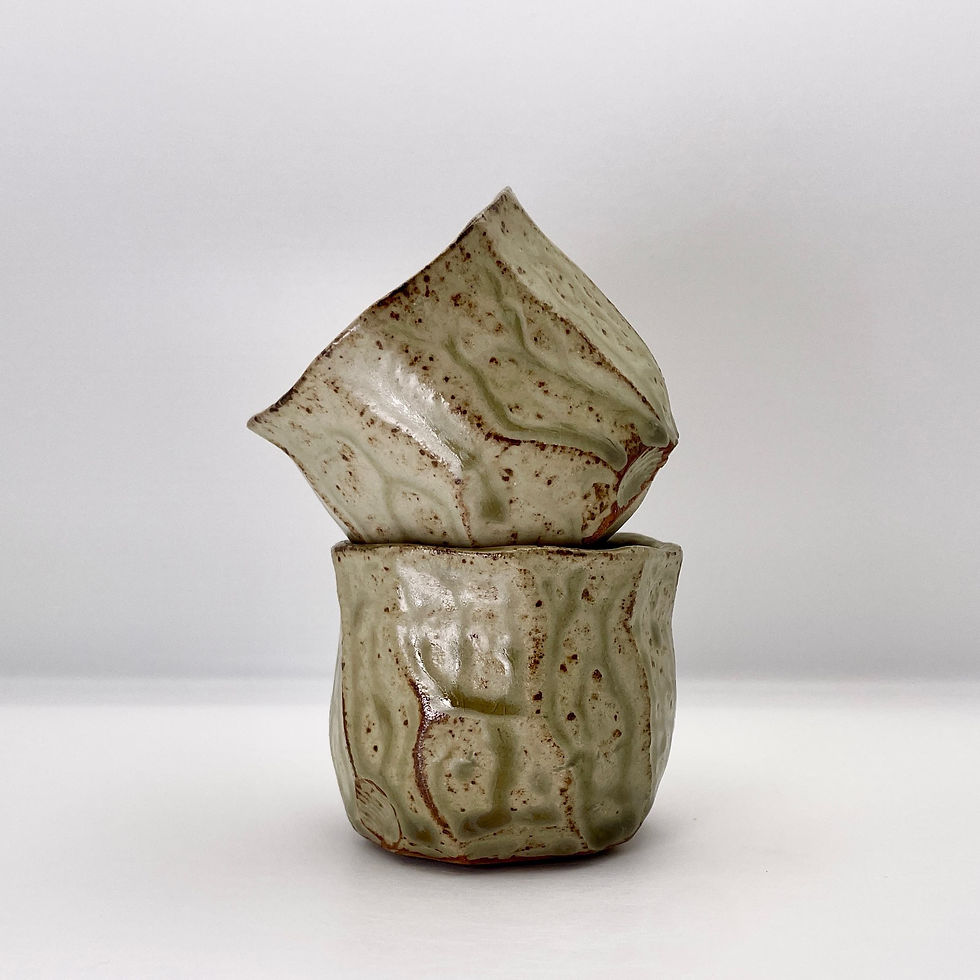
With a focus on subdued autumn colours, organic shapes and pots that embody movement and life, this Autumn Collection is the result of several months of exploration of character and animation within functional ceramics. Through the use of techniques that encourage asymmetry, irregularity, expression and visible traces of formation, I hope that this work feels organic and subtly alive. These qualities, along with the depth offered by the interplay of light, shadow and glaze, create objects that are tactile and interesting and, I hope, encourage a more intimate connection with their user.

Context and Starting Points
This project began in July. After an intense few months of shows, open studios, wood firings, teaching and finishing my summer collection, I felt inspired by the work I had seen and people I had met, but needed some time to refocus and explore. I visited London and spent a day at the Victoria and Albert Museum, moving between ancient ceramics and contemporary work, noting connections and what elements I was drawn to. Seeing objects from different periods and cultures side by side highlighted the long history of functional pots and the ways people have assigned meaning to them through use. In particular, a small, late 16th/early-17th century incense box from Iga, Japan caught my eye.
Above: A few (of many) favourites from the V&A. Clockwise from top left: Porcelain box with bluish white qingbai glaze, likely North Song Dynasty China, (960–1127); Jennifer Lee’s Speckled shale, trace, haloed granite band, tilted olive rim (2019); White Teapot by Edmund de Waal (1996); Kurinuki incense box from Iga, Japan, 1590–1630. The simplicity of the box—so unassuming—stayed with me long after I left the museum.
Also during the visit, I purchased a soda-fired cup by Petra Steward from Contemporary Ceramics. It instantly became my favourite coffee cup, and drinking from it each morning became unexpectedly influential. It's a deceptively simple handbuilt form, almost jaunty in its stance, but softly so. It has a weight that feels comforting, and every softened edge is nice to drink from. The layered slips and glaze create a single surface layer that is deep and complex and interesting, almost like the fur of an animal. It is beautiful, and I am already very attached to it. It is the kind of “animated” functional object I wanted to explore—work that feels alive because it invites closer consideration and, in turn, leads the user to assign meaning to it through everyday use.
The influences for my work are broad, and I follow thoughts and feelings of any kind in my making: the colour of the sea in summer, or the bands of rock along the Anglesey coastline; the hard science of glaze chemistry, the ergonomics of function. I live on an island, and the influence of the coastline continues to be present throughout this collection; however, the Iga incense box and Petra Steward’s cup seemed to me the primary catalysts for the new exploration.

Techniques Used
Kurinuki
Kurinuki is a Japanese pottery technique where a solid block of clay is carved and hollowed to create a vessel or box. It is very sculptural and engaging work. The Iga incense box highlighted the effectiveness of this early carving method for me and I searched and examined some work online made through this technique. In my studio, I started by shaping blocks of clay into jaunty rectangles, before leaving them to dry for a day or two. Working at the correct stage of dryness is essential: if the clay is too soft, the walls move under pressure; too hard, and cutting is almost impossible.
Once the clay was ready, I used knives, wires and loop tools to remove clay to create the internal cavity and exterior form simultaneously. The resulting surfaces intentionally retain tool marks, ridges and irregularities. Like rocks and geologic formations, these features are a record of the forming process, and they contribute directly to the sense of energy in the finished piece. I also aimed to lift each block from the surface by using feet or undercutting.


Carving and Faceting Thrown Forms
The idea of carving and altering shapes through Kurinuki led me to explore carving and faceting in wheel-thrown work. I already use carving for surface texture in my work but faceting (taking away larger amounts of clay) required a slightly different approach. For the faceted cups, bowls and vases, I threw forms on the wheel with thicker walls than usual and kept the profile slightly narrower. This allowed material to be removed later without compromising strength.
Once the clay had dried a little, I faceted the surfaces using a cheesewire and occasionally metal ribs or trimming tools. At this stage, I concentrated on structural logic: balanced facets, consistent wall thickness and controlled transitions. After faceting, I put the piece back on the wheel and gently opened it up a little more. This further shaping removes the rigidity introduced by the faceting and helps achieve a more fluid, asymmetric and organic silhouette.
I trimmed the bases once the pots were leather hard. Using a curved trimming tool, I undercut the base slightly to create a shadow gap. This technique is widely used in ceramic design to lift pots from the surface they sit on, improving the silhouette and enhancing the perception of movement and lightness. I also added shell imprints to many of them, which offers continuity with my existing work and links to my home here on Ynys Môn.


Firing and Glazes
This work was fired in the Girel 3E wood kiln at Mid Wales Arts Centre in Powys. Throughout the past year, I have tested a range of wood-firing glaze types, including celadons, ash glazes and shinos, along with several formulations developed in the studio, and have settled on some that I enjoy. However, the unpredictability of the flames, ash and temperature in each firing forces me to relinquish some control, which I value.
The palette for this collection is intentionally muted. Rather than competing with the form, these glazes highlight texture, tool marks, flame patterns and the way light moves across the pot. I’ve found that quieter surfaces often bring out more character in the work—they support the sense of animation without overwhelming it.


Finished Work and Final Thoughts
This project has been a really enjoyable one to work on, and I’m pleased with how the pieces have developed over the past few months. The ideas, techniques and aesthetics explored here feel like they’ll stay with me as I continue to make—particularly the focus on asymmetric forms and kurinuki. I also hope to further explore the subtle sense of animation within functional pots. I’m looking forward to further developing my understanding of wood firing, testing new glazes suited to that atmosphere, and refining both my kurinuki approach and the range of shapes and carving methods I use. There’s a lot still to learn, and I’m excited to see where it leads.
Below is a small selection of finished work from this exploration.


Comments